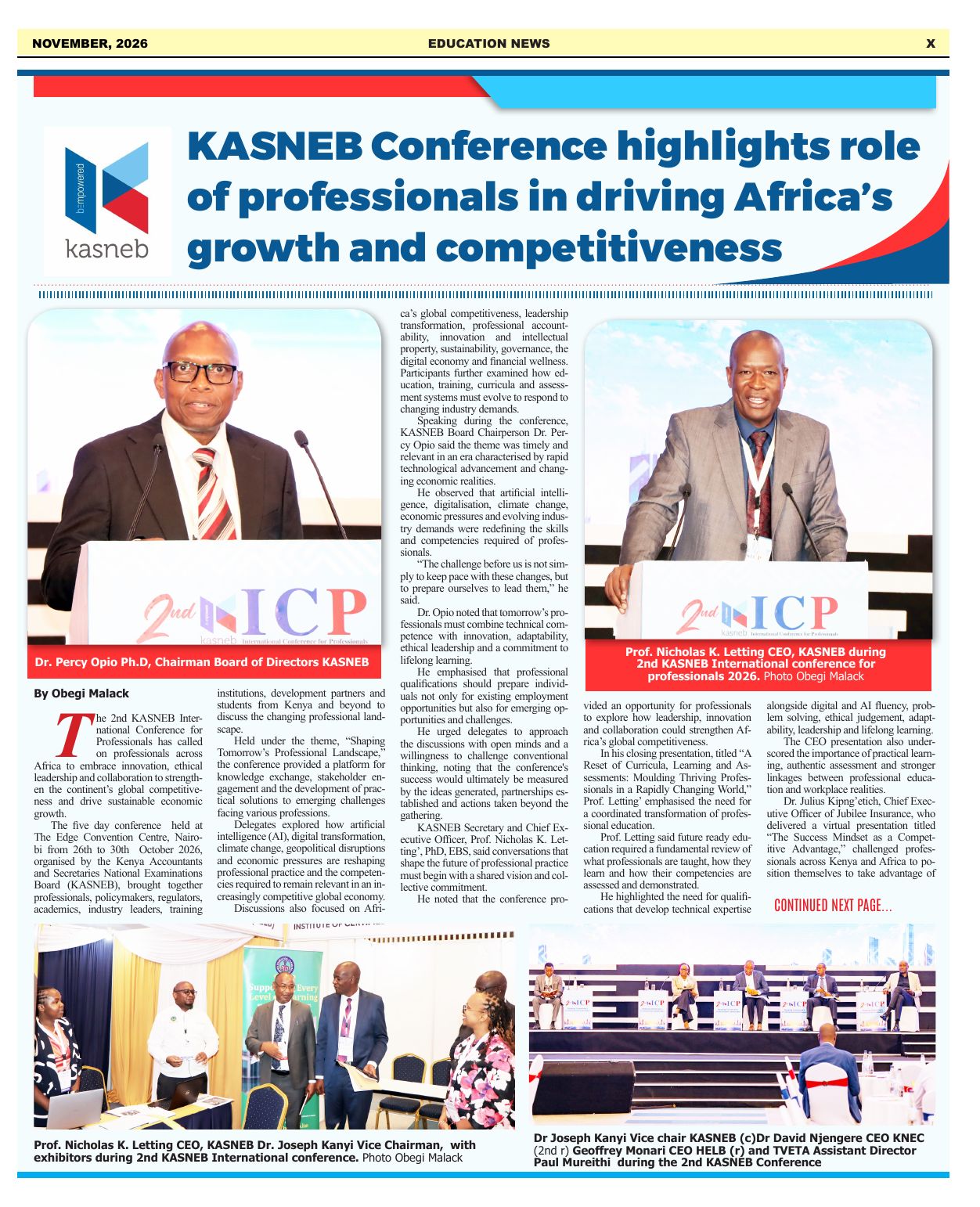
KASNEB Conference highlights role of professionals in driving Africa’s growth and competitiveness
By Obegi Malack | Education News, November 2026
The 2nd KASNEB International Conference for Professionals has called on professionals across Africa to embrace innovation, ethical leadership and collaboration to strengthen the continent’s global competitiveness and drive sustainable economic growth.
The five-day conference, held at The Edge Convention Centre, Nairobi, from 26th to 30th October 2026 and organised by the Kenya Accountants and Secretaries National Examinations Board (KASNEB), brought together professionals, policymakers, regulators, academics, industry leaders, training institutions, development partners and students from Kenya and beyond to discuss the changing professional landscape.
Held under the theme “Shaping Tomorrow’s Professional Landscape,” the conference provided a platform for knowledge exchange, stakeholder engagement and the development of practical solutions to emerging challenges facing various professions.
Delegates explored how artificial intelligence (AI), digital transformation, climate change, geopolitical disruptions and economic pressures are reshaping professional practice and the competencies required to remain relevant in an increasingly competitive global economy.
Discussions also focused on Africa’s global competitiveness, leadership transformation, professional accountability, innovation and intellectual property, sustainability, governance, the digital economy and financial wellness. Participants further examined how education, training, curricula and assessment systems must evolve to respond to changing industry demands.
Preparing to lead change
Speaking during the conference, KASNEB Board Chairperson Dr. Percy Opio said the theme was timely and relevant in an era characterised by rapid technological advancement and changing economic realities.
He observed that artificial intelligence, digitalisation, climate change, economic pressures and evolving industry demands were redefining the skills and competencies required of professionals.
“The challenge before us is not simply to keep pace with these changes, but to prepare ourselves to lead them,” he said.
Dr. Opio noted that tomorrow’s professionals must combine technical competence with innovation, adaptability, ethical leadership and a commitment to lifelong learning. He emphasised that professional qualifications should prepare individuals not only for existing employment opportunities but also for emerging opportunities and challenges.
He urged delegates to approach the discussions with open minds and a willingness to challenge conventional thinking, noting that the conference’s success would ultimately be measured by the ideas generated, partnerships established and actions taken beyond the gathering.
KASNEB Secretary and Chief Executive Officer, Prof. Nicholas K. Letting’, PhD, EBS, said conversations that shape the future of professional practice must begin with a shared vision and collective commitment. He noted that the conference provided an opportunity for professionals to explore how leadership, innovation and collaboration could strengthen Africa’s global competitiveness.
In his closing presentation, titled “A Reset of Curricula, Learning and Assessments: Moulding Thriving Professionals in a Rapidly Changing World,” Prof. Letting’ emphasised the need for a coordinated transformation of professional education.
Prof. Letting’ said future-ready education required a fundamental review of what professionals are taught, how they learn and how their competencies are assessed and demonstrated. He highlighted the need for qualifications that develop technical expertise alongside digital and AI fluency, problem solving, ethical judgement, adaptability, leadership and lifelong learning.
The CEO’s presentation also underscored the importance of practical learning, authentic assessment and stronger linkages between professional education and workplace realities.
Dr. Julius Kipng’etich, Chief Executive Officer of Jubilee Insurance, who delivered a virtual presentation titled “The Success Mindset as a Competitive Advantage,” challenged professionals across Kenya and Africa to position themselves to take advantage of emerging opportunities. He underscored the importance of agility in today’s professional landscape, noting that professionals must remain adaptable and responsive to rapidly changing circumstances to sustain their relevance and effectiveness.
Regulation, TVET and AI
On legislative and regulatory reforms, Ms. Pauline Moranga, representing the Attorney General’s Office, explored the importance of responsive and forward-looking legal and regulatory frameworks in addressing emerging challenges, technological advancements and changing professional landscapes. She noted that regulatory agility was essential in fostering innovation, strengthening governance and ensuring that legal frameworks remained relevant and effective in a rapidly changing world.
The role of technical and vocational education and training (TVET) in preparing Kenya’s workforce for a changing economy also featured prominently. During a session titled “Transforming TVET for the Future: Bridging Skills, Professional Qualifications and Industry Needs in a Changing Economy,” Mr. Tom Otieno Olang’o, Director of TVET Policy Formulation, Development and Implementation, representing Dr. Esther Thaara Muoria, PhD, CBS, Principal Secretary, State Department for Technical, Vocational Education and Training, emphasised the importance of equipping learners with practical skills that respond to industry needs.
He observed that Kenya’s economic transformation depended on a workforce capable of translating knowledge into practical solutions, driving innovation and improving productivity. He further called for stronger collaboration between TVET institutions and professional bodies to align training with industry standards, strengthen professional qualifications and create clear pathways for career progression.
With digitalisation, artificial intelligence, automation and green technologies reshaping the world of work, he emphasised that continuous skills development was essential in ensuring professionals remained relevant and competitive.
The conference also examined the growing influence of artificial intelligence on professional practice, particularly the need to balance technological advancement with ethical responsibility. During a session titled “Smarter, Faster, Different and Ethical: Keeping it Professional in the Era of AI,” Mr. Adam Lane, Director of Policy and Partnerships at Huawei Kenya, explored how professionals could harness AI to improve efficiency and innovation while maintaining ethical standards, accountability and public trust.
He noted that as technology continued to transform professional practice, integrity and responsible use of digital tools remained critical in safeguarding confidence in professional institutions.
Training for a changing world of work
Another key discussion examined whether existing training systems were adequately preparing professionals for the changing world of work. During the panel discussion titled “Are we training professionals for a world that no longer exists? Showcasing transformations in training,” participants called for a shift from traditional training approaches towards practical, competency-based and industry-responsive learning.
The panel brought together Mr. Shadrack Tonui, Chairman of the Kenya Association of Technical Training Institutions; Dr. Charles Koech, OGW, Chief Principal of Eldoret National Polytechnic; Dr. Mutembei Kigige, PhD, Chief Principal of Meru National Polytechnic; CPA Ronoh Benhard Benson, Founder and Chief Executive Officer of Synapse Global Institute Limited; and Dr. Joshua Aura, PhD, CPA, Chief Executive Officer of RCM College.
The panellists highlighted the need for stronger industry linkages, continuous curriculum reviews and training programmes that equip learners with practical competencies applicable in real workplace situations. They observed that preparing future-ready professionals required institutions to move beyond conventional approaches and align their programmes with emerging technologies, changing industry demands and evolving workplace realities.
The future of education and professional standards also featured in discussions during the final day of the conference. Under the topic “Future-proofing Academic and Professional Standards Through Innovation in a Rapidly Changing World,” a panel examined how institutions could maintain the quality and relevance of their qualifications while responding to emerging technologies, changing industry expectations and evolving skills requirements.
The discussion brought together Dr. Alice Kande, Director General of the Kenya National Qualifications Authority (KNQA); Dr. David Njengere, Chief Executive Officer of the Kenya National Examinations Council (KNEC); and Mr. Geoffrey Monari, Chief Executive Officer of the Higher Education Loans Board (HELB), alongside representatives from the TVET Authority. The session was moderated by Dr. Joseph Kanyi, Vice Chairman of the KASNEB Board.
The panellists emphasised the importance of innovation, institutional collaboration and continuous review of academic and professional frameworks to ensure education translates into relevant skills, meaningful opportunities and a workforce prepared for future demands.
Turning ideas into impact
Delivering the closing remarks under the topic “Turning Ideas into Impact Beyond the Conference,” FCPA Geoffrey Malombe, HSC, ‘ndc’, Director of National Assets and Liabilities Management at The National Treasury, representing Mr. Lawrence Kibet, Director General of Public Investments and Portfolio Management, challenged professionals to translate the discussions and insights from the conference into tangible results.
He called for clear ownership of agreed actions, defined implementation timelines, regular progress reviews and sustained investment in future-ready skills, including digital and AI competencies, sustainability reporting, cybersecurity and forensic skills, all underpinned by strong professional ethics.
The director further emphasised the importance of partnerships among government institutions, professional bodies, regulators, the private sector, academia and development partners in addressing institutional and national challenges.
The conference culminated in a series of recommendations aimed at strengthening professional education, technological adoption, ethical leadership and institutional accountability.
Under professional education, qualifications and assessment, delegates called for stronger collaboration among industry players, training institutions, examining bodies and curriculum developers. They recommended increased use of virtual learning, industrial attachments for students and regular industry exposure for trainers to ensure training programmes respond to the actual needs of the economy, particularly micro, small and medium enterprises (MSMEs).
Training institutions and professional bodies were also urged to prepare learners for emerging opportunities in artificial intelligence, the green economy and digital work while aligning their programmes with international standards to enhance the competitiveness of Kenyan professionals in regional and global labour markets.
The delegates further called on regulators, examining bodies and professional organisations to promote flexible learning pathways under the Kenya National Qualifications Framework. These would include micro-credentials, recognition of prior learning and credit transfers to enable individuals to acquire, demonstrate and advance their skills throughout their careers.
On artificial intelligence, technology and data, professionals were encouraged to embrace emerging technologies confidently and responsibly while remaining accountable for their work. They were urged to verify AI-generated outputs, safeguard confidential information and exercise independent professional judgement when using digital tools. Institutions were also challenged to develop clear policies governing the use of artificial intelligence, guided by recognised standards such as ISO/IEC 42001 and the emerging Kenyan Code of Practice on Artificial Intelligence.
Under ethics, governance and public trust, the conference reaffirmed that integrity remains the foundation of every profession. Delegates called for stronger institutions anchored on sound values, transparency, accountability, resilience and effective governance systems that outlast individual officeholders.
Professionals and professional bodies were also urged to play a greater role in overseeing public borrowing, including independently assessing the value for money and affordability of publicly financed projects and reviewing their outcomes. They further called on professionals to take a leading role in climate action, sustainability reporting and responsible environmental, social and governance (ESG) practices.
Delegates were challenged to translate the ideas, partnerships and commitments generated into meaningful action. The conference underscored the need for professionals to anticipate change, embrace innovation and uphold ethical standards while contributing to Africa’s economic transformation and global competitiveness.